
In regions such as the Middle East, where outdoor temperatures can become extremely high during summer, waiting for a bus can be uncomfortable, especially in areas with limited shade.
This raises an important question for public transportation planners and project developers: Can an air-conditioned bus shelter really provide a comfortable waiting environment in extreme heat?
The answer is yes, provided that the shelter is properly designed. However, installing an air conditioner alone is not enough. Cooling performance depends on the overall structure, insulation, glass selection, ventilation, door design, and power supply.
At Shanghai RUSUU, we provide customized enclosed bus shelter solutions that can integrate air conditioning, passenger information displays, solar power systems, and other optional features according to project requirements.
1. Why Does an Air-Conditioned Bus Shelter Need Special Design?
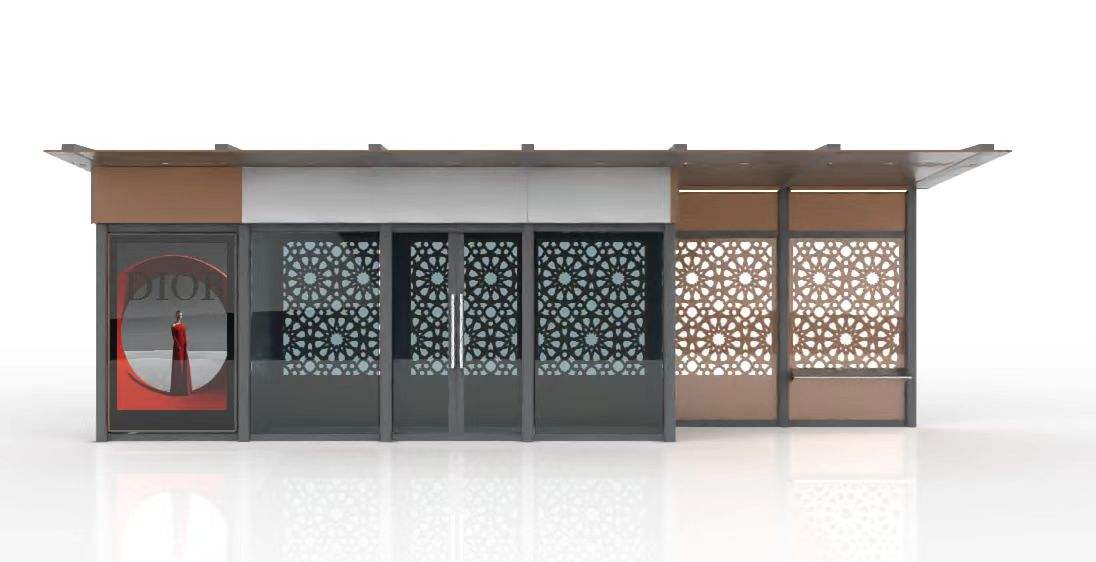
Unlike a conventional indoor room, a bus shelter is exposed to direct sunlight and changing outdoor conditions.
Heat can enter through the roof, glass panels, metal structures, and frequently opened doors. Direct solar radiation can also increase the temperature of interior surfaces.
Several factors should therefore be considered before selecting an air-conditioning system:
- Outdoor temperature: Local summer temperatures determine the cooling conditions the system must handle.
- Shelter dimensions: Interior volume affects the required cooling capacity.
- Glass area: Large glass panels can increase solar heat gain, particularly when exposed to direct sunlight.
- Insulation: Roof and wall insulation help reduce heat transfer from the outdoor environment.
- Passenger traffic: Frequent door openings and changing passenger numbers influence indoor temperatures.
- Ventilation: Fresh-air requirements must be balanced with cooling efficiency.
A suitable cooling solution should be selected based on the complete shelter design rather than air-conditioner capacity alone.
2. How Can Bus Shelter Design Reduce Indoor Heat?
A well-designed enclosed bus shelter should minimize unnecessary heat entering the interior before relying entirely on air conditioning.
Roof Insulation
The roof receives substantial solar exposure. Suitable insulation materials and a properly designed roof structure can help reduce heat transfer into the shelter.
Glass Selection
Large glass panels provide visibility and a modern appearance, but they can also contribute to indoor heat gain.
Depending on the project, suitable glass specifications, solar-control glass, or shading solutions can help improve thermal performance.
Door and Sealing Design
Automatic doors or well-fitted entrance doors can help limit the exchange of hot outdoor air with cooled indoor air.
Door configuration should also consider passenger flow, accessibility, and safe operation.
Airflow Distribution
The position of the air-conditioning unit and air outlets affects how cool air circulates throughout the shelter.
Good airflow distribution helps avoid areas that are excessively warm or uncomfortable.
3. How Much Air-Conditioning Capacity Does a Bus Shelter Need?
There is no universal air-conditioning specification for every bus shelter.
A small enclosed shelter and a larger passenger waiting space have different cooling requirements.
Before selecting an air-conditioning unit, project designers should consider:
- Internal length, width, and height
- Expected outdoor temperature
- Roof and wall insulation
- Glass type and total glazing area
- Average passenger occupancy
- Door opening frequency
- Required indoor temperature
- Fresh-air ventilation requirements
These factors help determine the appropriate cooling capacity and operating configuration.
Choosing an undersized system may result in insufficient cooling, while an oversized system can increase equipment and energy costs without necessarily improving overall efficiency.
For this reason, cooling capacity should be evaluated during the design stage.
4. Can Solar Power Run an Air-Conditioned Bus Shelter?
This is another common question among buyers interested in solar-powered bus shelters.
Solar panels can provide renewable electricity, but air conditioning generally requires considerably more power than basic functions such as LED lighting or passenger information displays.
Whether a solar-powered system can support air conditioning depends on several factors:
- Solar panel output and available installation area
- Local sunlight conditions
- Air-conditioner power consumption
- Daily operating hours
- Battery storage capacity
- Energy losses and backup power arrangements
For projects with substantial cooling requirements, a grid-connected or hybrid power configuration may be more practical than relying entirely on a standalone solar system.
At RUSUU, solar panels, battery storage, and electrical configurations can be considered according to the project’s actual energy requirements.
The goal is to develop a realistic power solution rather than assume that a roof-mounted solar panel can operate every electrical device independently.
5. What Should Buyers Consider When Choosing an Air-Conditioned Bus Shelter?
For projects in hot regions, buyers should evaluate more than the appearance of the shelter or the advertised air-conditioning capacity.
Important considerations include:
Thermal Performance: Ask about roof insulation, glass specifications, door sealing, and the proposed cooling design.
Electrical Configuration: Confirm the required power supply, air-conditioning load, electrical protection, and backup arrangements.
Maintenance Access: Air-conditioning filters, drainage, electrical components, and other equipment should be accessible for inspection and servicing.
Structural Durability: Outdoor materials and protective finishes should be suitable for local temperature, sunlight, dust, and weather conditions.
Passenger Safety: Door operation, ventilation, emergency access, and electrical safety should be considered as part of the overall design.
A properly planned system can help create a more comfortable waiting environment while supporting reliable daily operation.
6. Customized Air-Conditioned Bus Shelter Solutions by RUSUU
Shanghai RUSUU specializes in the research, development, manufacturing, and service of intelligent public transportation facilities.
Our product range includes standard bus shelters, enclosed bus shelters, solar-powered bus shelters, and smart bus stop information systems.
For hot-climate projects, RUSUU can provide customized enclosed bus shelter configurations incorporating:
- Air-conditioning systems
- Enclosed structures with glass panels
- Insulated roof configurations
- Automatic door options
- LCD passenger information displays
- LED lighting systems
- Solar panels and battery storage options
- USB and wireless charging facilities
Different projects require different configurations. For example, a bus shelter in the Middle East may prioritize thermal comfort, solar protection, and cooling performance, while a European project may place greater emphasis on architectural integration and weather protection.
As a bus shelter manufacturer, RUSUU works with customers to develop solutions based on project dimensions, local climate conditions, functional requirements, and installation environments.
Conclusion: Is an Air-Conditioned Bus Shelter Worth Considering?
Air-conditioned bus shelters can provide a more comfortable waiting environment in extremely hot regions, but their effectiveness depends on the entire design.
Insulation, glass selection, door sealing, cooling capacity, ventilation, and power supply must work together. Simply installing an air conditioner does not guarantee satisfactory cooling performance.
For public transportation authorities, contractors, and urban infrastructure developers, working with an experienced manufacturer from the early design stage helps ensure that the shelter’s structure and cooling system are properly coordinated.
Planning an air-conditioned bus shelter project for a hot climate?
Contact Shanghai RUSUU to discuss customized enclosed bus shelters, cooling configurations, solar power options, and smart public transportation facilities.
Post time: Nov-27-2026